
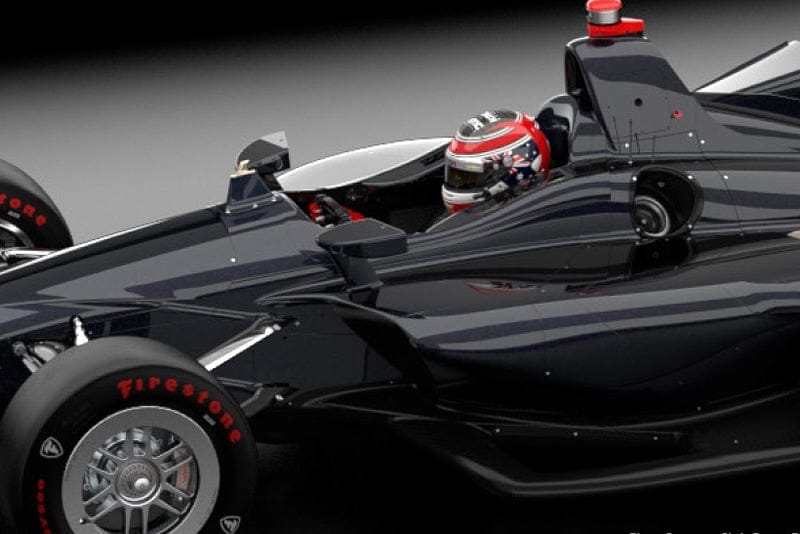
The NTT IndyCar Series has today unveiled the newest iteration of cockpit protection which will be fitted to all cars in the upcoming 2019 championship. The cockpit protection, known as Advanced Frontal Protection or AFP, is a small piece of bodywork mounted directly in front of the driver. The piece is designed to deflect any potential debris away from the driver.
The Advanced Frontal Protection is around three inches tall and approximately a quarter of an inch wide. As a result, it is a much less visually intrusive method of cockpit protection than the likes of Formula 1‘s controversial HALO.
The AFP has also undergone various strength tests by IndyCar officials, who have ensured that the device has the same strength as the roll hoop on the Dallara IndyCar body.
In the last few seasons in IndyCar, a number of incidents have occurred where debris has ended up striking or nearly striking a driver on the track. One of the most notable examples of this happening includes the 2014 Grand Prix of Indianapolis, where James Hinchcliffe suffered a concussion after being hit on the head by debris.
Today’s introduction to the AFP is understood to be the first in a series of changes to help improve safety in the NTT IndyCar Series. IndyCar president, Jay Frye, said today that the AFP was the “latest step in the evolution” of IndyCar safety.
“Safety is a never-ending pursuit, and this is INDYCAR’s latest step in the evolution,” Frye said. “There are more details to come about the phases to follow.”
Like other single-seater racing championships over the last few years, IndyCar has carried out numerous tests with various methods of preventing driver injury. Perhaps the standout moment took place prior to the 2018 season, where Chip Ganassi Racing‘s Scott Dixon took part in a lengthy on-track test at ISM Raceway with a canopy-style protection system.
Unlike Formula 1’s similar ‘aero-screen’ test – which was quickly deemed a failure following a short on-track test with Sebastian Vettel in practice for the 2017 British Grand Prix – Dixon’s test with a windscreen went largely positively, with only a few minor areas to improve on.
It is understood, however, that numerous further tests of the IndyCar windscreen have unearthed some more issues that need to be rectified, but the concept has not been scrapped. Instead, today’s newly announced AFP device will be used in the meantime whilst further research is undertaken by IndyCar.
The Advanced Frontal Protection device will make it’s on-track debut at an open test at Indianapolis Motor Speedway on April 24. The first race with the AFP device will be the 2019 Indianapolis 500 on Sunday, May 26, with all the cars set to carry the device for the remainder of the season after that.
The 2019 NTT IndyCar Series will kick-off with the season-opening Grand Prix of St. Petersburg on Sunday, March 10.